Because the official narrative rarely tells the whole story.
WEDNESDAY, OCTOBER 28, 2026
From the Joint Chiefs’ Sunday meeting to the release of the notes
13,213 DAYS
OCT 28, 1962  →  DEC 31, 1998
RAY COULTER TODAY IN THE ARCHIVE
On October 28, 1962, Curtis LeMay argued for a Monday strike on Cuba the same morning Moscow backed down
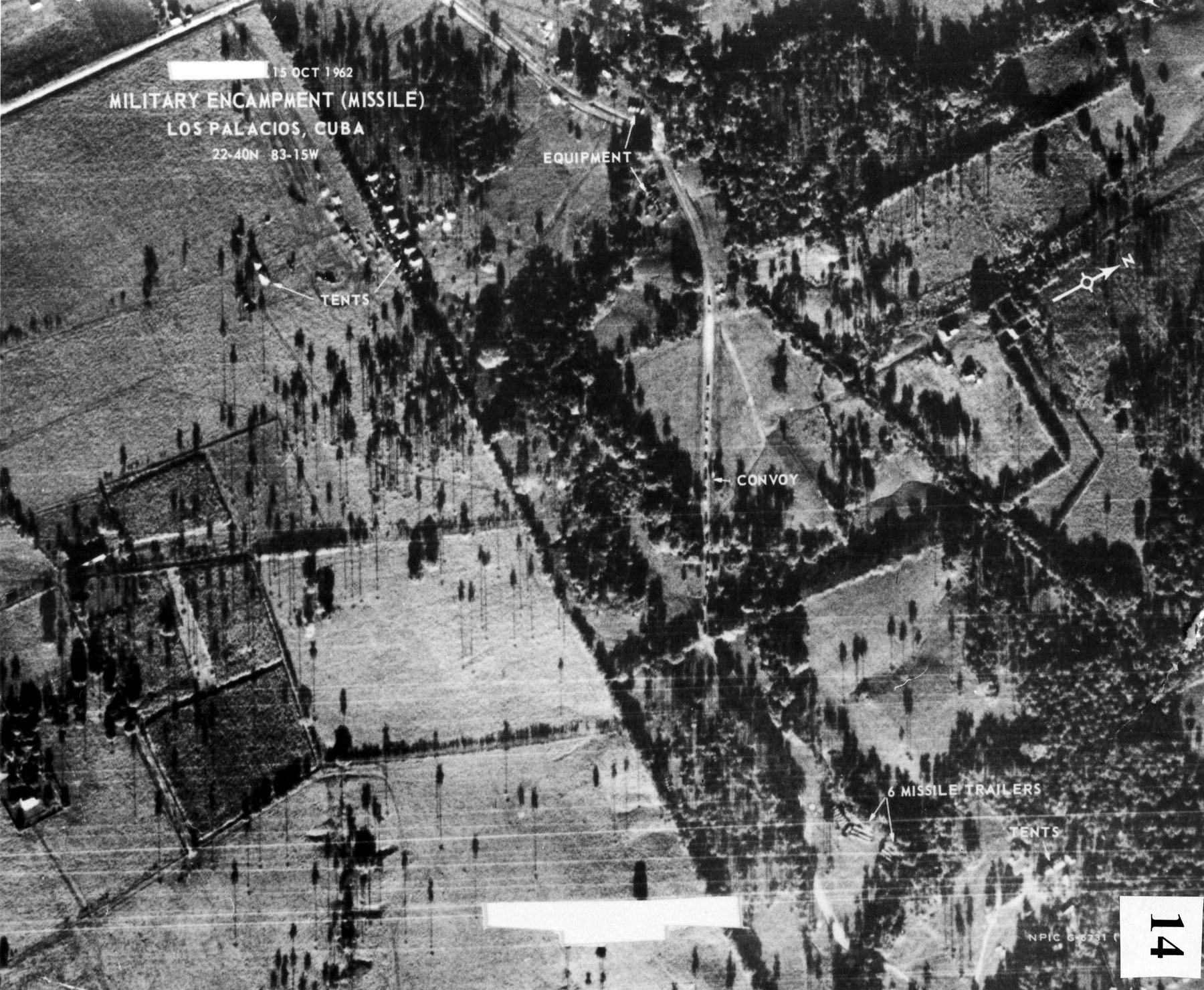
Black and white aerial photograph of a Soviet missile truck convoy near San Cristobal, Cuba, in October 1962
A Soviet missile convoy near San Cristobal, Cuba, photographed from Maj. Richard Heyser’s U-2 on October 14, 1962 (Photo: U.S. Air Force)
There is one line in a Joint Chiefs file that has kept me at the dining room table three nights this week. My wife Marilyn says the scanner will still be there in the morning. At a 9 a.m. meeting on Sunday, October 28, 1962, General Curtis LeMay of the Air Force told the other chiefs, “Monday will be the last time to attack the missiles before they become fully operational.”
LeMay lost that argument. The other four chiefs chose to wait for the day’s photographs, and Kennedy sent no bombers.
By about 9:30, a tickertape of Moscow Radio was going around the room. Khrushchev had ordered his officers to stop building the bases and bring the missiles home.
If you were alive that week, you remember how close it felt. These notes show you how close it got inside the Joint Chiefs’ own meeting.
To see why LeMay wanted Monday, you have to go back one day, to Saturday, October 27.
That afternoon, the Joint Staff put a paper on the table calling for “early and timely execution” of the air strike plan. Defense Secretary Robert McNamara asked what that meant. LeMay told him, “Attacking Sunday or Monday.”
At 2:03, Colonel Steakley of the Joint Reconnaissance Group walked in. A U-2 flying over Cuba was 30 to 40 minutes overdue…
Major Rudolf Anderson Jr. was the pilot. He had been shot down and killed over Cuba.
Later that afternoon, General Maxwell Taylor, the chairman, took the Joint Chiefs’ memo to the White House and read it to Kennedy’s advisers. At 6:30 he reported back to the chiefs that the memo said “we should attack no later than 29 October.”
Monday, October 29, was the deadline the Joint Chiefs had set for themselves. When LeMay asked for Monday the next morning, he was holding them to it.
You already know how that Sunday went.
What McNamara had ready
Before Khrushchev’s message came in on Sunday, Robert McNamara had a list of new ways to squeeze Moscow. Which of these were on it?
▪  Keep Army and Air Force men on duty past the end of their tours.
▪  Set up a submarine intercept zone.
▪  Add petroleum, oil and lubricants to the contraband list.
▪  Requisition shipping.
Answer at the bottom of this letter.
“If the warheads are with the missiles, they can be made ready to fire in 2½ to 5 hours.”
GEN. EARLE WHEELER, ARMY CHIEF OF STAFF, OCTOBER 28, 1962, AS GIVEN IN THE JCS NOTES
The file
Document
“Notes Taken From Transcripts of Meetings of the Joint Chiefs of Staff, October–November 1962, Dealing With the Cuban Missile Crisis”
Meeting
Sunday, October 28, 1962, 0900
Speakers
Gen. Curtis LeMay, Gen. Maxwell Taylor, Gen. Earle Wheeler, Adm. George Anderson Jr., Robert McNamara
Notes made
By hand in 1976, typed in 1993
Classified
Secret
Held by
DOD, Office of the Chairman of the Joint Chiefs of Staff, Office of Joint History
Outcome
The other chiefs waited for Sunday’s photographs. Kennedy ordered no strike.
Released
December 31, 1998, in the State Department’s FRUS microfiche supplement, Document 441
Curtis LeMay died on October 1, 1990. The State Department put his Sunday morning in front of the public on December 31, 1998, on microfiche, eight years after his death.
I was thirteen that Sunday, in Dayton, Ohio. LeMay was born up the road in Columbus.
Dad kept the kitchen radio on all weekend. My brother Denny, three years older than me, did his homework beside it with the sound turned low…
Six years later Denny was in Vietnam. He came home in 1969 and talked Cardinals baseball with me for fifty-two years. Vietnam stayed outside every one of those talks.
I read files about how men like Denny ended up over there. This one is about a Monday that came and went with the bombers still parked.
The other four chiefs wanted to see Sunday’s pictures before they backed a strike. Rudolf Anderson had died taking pictures over Cuba one day earlier.
The plan for Sunday sent six low-level planes over Cuba, routed away from the sites with antiaircraft guns. Waiting for those pictures bought the morning, and Khrushchev’s message used it.
JOINT CHIEFS OF STAFF
OFFICE OF JOINT HISTORY
S E C R E T   DECLASSIFIED
Sunday, 28 October
NOTES TAKEN FROM TRANSCRIPTS OF MEETINGS OF THE JOINT CHIEFS OF STAFF
JCS meeting at 0900:
CSAF: I want to see the President later today, and I hope all of you will come with me. Monday will be the last time to attack the missiles before they become fully operational.

CJCS: If you want a meeting, I will put in your request.
Released
Dec. 31, 1998
Dept. of State
 
FRUS, 1961–1963, Vols. X/XI/XII, Microfiche Supplement, Document 441. Original: DOD, Office of the Chairman of the Joint Chiefs of Staff, Office of Joint History. Secret. 3 pp. Excerpt of facsimile page 2.
How long it sat
October 27, 1962: Maj. Rudolf Anderson Jr. is shot down and killed over Cuba. The Joint Chiefs recommend attacking no later than October 29.
October 28, 1962: LeMay asks to see President Kennedy at the 9 a.m. meeting. By about 9:30 the Moscow Radio tickertape is going around the room.
1976: Notes are written by hand from the JCS meeting transcripts.
October 1, 1990: Curtis LeMay dies.
1993: The 1976 notes are typed.
December 31, 1998: The State Department releases them on microfiche. That is 13,213 days after the meeting.
Ray’s note
I filed copies for 26 years, and this one is a copy of a copy: notes on transcripts, written by hand in 1976, typed in 1993. Thirty-one years after the meeting, LeMay’s Monday finally got typed up clean.
Line of the Day
“CSAF still wants to go to the White House, but other JCS members decide to wait and see whether reconnaissance flights meet opposition and what their pictures show.”
Notes from transcripts of JCS meetings, October 28, 1962
FRUS, 1961–1963, Vols. X/XI/XII, Microfiche Supplement, Document 441
The answer
All four. McNamara named every one at the Joint Chiefs’ meeting on October 28, 1962: longer tours, a submarine intercept zone, petroleum on the contraband list and requisitioned shipping. Then the Moscow Radio tickertape came around, and his list stayed a list.
How long should the Joint Chiefs’ notes from that Sunday have stayed shut?
Tap one. It opens a letter to the desk with your answer in the subject line.
One tap, no login.
Where were you on Sunday, October 28, 1962? Hit reply and tell me. I read the letters at the dining room table, next to the two file boxes Marilyn wants moved.
The request desk
Name a file you want pulled. Give me an operation, a date or a name, and I will go looking for the paper.
NAME A FILE →
What I still cannot find
Document 441 answers one question and leaves three open.
▪  The 1976 handwriting. State Department editors printed the 1993 typed pages, and I have not seen the notes in the hand that wrote them.
▪  What LeMay said if he reached Kennedy on October 28. These notes for that Sunday stop with the other chiefs choosing to wait.
▪  The JCS transcripts themselves. Those 1993 pages are notes taken from them, and they give the transcripts in pieces.
Marilyn came out at midnight and read the line over my shoulder. She said, “Monday came anyway, Ray.”
It did. I went to school in Dayton that Monday with my lunch in a paper sack.
Talk tomorrow,
Ray
Further Reading:
“If you want a meeting, I will put in your request.” Every line from that Sunday morning, typed in 1993: Notes from transcripts of JCS meetings, October 28.
“The President has a feeling that time is running out.” Saturday, October 27, hour by hour: Notes from transcripts of JCS meetings, October 27.
“The superpowers were then very close to war.” From the Air Force museum, on the U-2 flights and Rudolf Anderson: The Cuban Missile Crisis.
“A popular Government, without popular information, or the means of acquiring it, is but a prologue to a Farce or a Tragedy; or perhaps both.”
JAMES MADISON, LETTER TO W. T. BARRY, AUGUST 4, 1822