|
Because the official narrative rarely tells the whole story.
|
|||||||
|
MONDAY, NOVEMBER 23, 2026
|
|||||||
|
From the engineer’s memo to the day you could read it
16,039 DAYS
OCT 22, 1969 → SEP 20, 2013
|
|||||||
|
|||||||
|
A Sandia engineer wrote in 1969 that one low voltage switch kept a hydrogen bomb from going off in North Carolina
|
|||||||
|
|||||||
|
I keep reading one sentence that a Sandia engineer named Parker F. Jones typed in October 1969, and it sits on my dining room table, next to the scanner and the two file boxes my wife Marilyn wants gone.
The bomb in that sentence did not go off. Jones wrote eight years after the crash, as one man at one lab, and his page stayed secret until 2013.
Why can’t I put it down? Part of it is one word I had to look up, because Jones called the switch “dynamo-technology.”
I was eleven that winter, in Dayton, Ohio, and what I remember is snow and my brother Denny’s paper route. North Carolina I learned about at sixty, from a file.
The sentence Jones typed is about a night in Wayne County, North Carolina, when a B-52 came apart in the air with two hydrogen bombs on board.
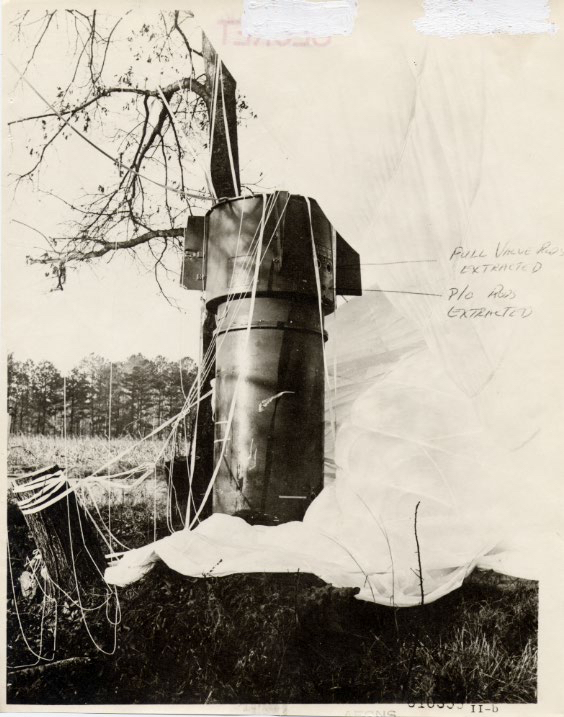
One of those bombs came down on its parachute and hung in a tree near Faro. Its parachute opened, its timer ran out, and its battery came alive. One switch, still set to SAFE, held the rest back...
|
|||||||
|
|||||||
|
|||||||
|
|||||||
|
To see how a bomb ends up in a tree, you have to go back to a little after midnight on January 24, 1961.
Major Walter Scott Tulloch was flying a B-52G out of Seymour Johnson Air Force Base on an airborne alert run. His plane had a fuel leak, and at 9,000 feet he told his crew to get out.
Five of the eight men lived, and Lieutenant Adam Mattocks, the third pilot, jumped through the top hatch on his own.
Weapon No. 2’s parachute stayed packed, so it hit a meadow off Big Daddy’s Road at about 700 miles an hour and drove itself into the mud.
That bomb went to Lieutenant Jack ReVelle, a 25-year-old Air Force bomb disposal officer. His squadron commander, whose name the NPR story does not give, called him one night and skipped the code words they had rehearsed.
ReVelle and his crew dug through snow, rain and frozen ground. His sergeant, whose name the StoryCorps tape leaves out, found the arm/safe switch.
ReVelle said, “Great.” The switch read ARM.
Sandia’s engineers later found that the crash had torn that switch loose from its wires. The Air Force gave up digging for the bomb’s secondary stage, and it is still under the field.
A year later, the physicist Ralph Lapp put the crash in a book called Kill and Overkill. He wrote that only a single switch had kept the bomb from going off.
Parker F. Jones ran nuclear weapons safety at Sandia. In 1969 he set Lapp’s passage in the left column of a page and wrote his answer down the right.
Jones found fault with Lapp’s facts. Then he backed Lapp on the part about the switch, and you already know the sentence he wrote for it.
He went further than Lapp did and wrote that the Mark 39 Mod 2 “did not possess adequate safety for the airborne alert role in the B-52.”
In plain words, the bombs were too unsafe for the job that plane was flying.
His page stayed secret for almost 44 years. Eric Schlosser asked for it under the Freedom of Information Act while he wrote a book on nuclear accidents, and The Guardian printed it on September 20, 2013.
In December 2018, ReVelle told the story to his daughter Karen for StoryCorps, and he said that after the dig, when he sat down to write his parents, his hand was shaking.
|
|||||||
Set from the three sentences quoted from the released memo. The layout is ours; the two scanned pages are on The Guardian’s site.
|
|||||||
|
|||||||
|
|||||||
|
|||||||
|
|||||||
|
|||||||
|
Were you near Goldsboro in January 1961, or stationed at Seymour Johnson? Hit reply and tell me what you saw. I read every letter at the dining room table.
|
|||||||
|
|||||||
|
|||||||
|
Marilyn came out at midnight and asked me what dynamo-technology means. I told her I think it means plain and old, a part you could hold in one hand.
My brother Denny came home from Vietnam the same year Jones typed that page. He talked to me about his truck, the Browns, the price of gas. The war sat in the middle of all that like a hole in a field.
That sentence is still on my table. One plain, low voltage switch...
I am leaving it there a while longer, Marilyn.
Talk tomorrow,
Ray
|
|||||||
|
|||||||
|
“A popular Government, without popular information, or the means of acquiring it, is but a prologue to a Farce or a Tragedy; or perhaps both.”
JAMES MADISON, LETTER TO W. T. BARRY, AUGUST 4, 1822
|