Because the official narrative rarely tells the whole story.
THURSDAY, OCTOBER 22, 2026
From the students’ march to the Legation’s verdict
56 DAYS
OCT 23, 1956  →  DEC 18, 1956
RAY COULTER TODAY IN THE ARCHIVE
The US Legation in Budapest wrote in 1956 that Hungarians heard a promise of help America never made
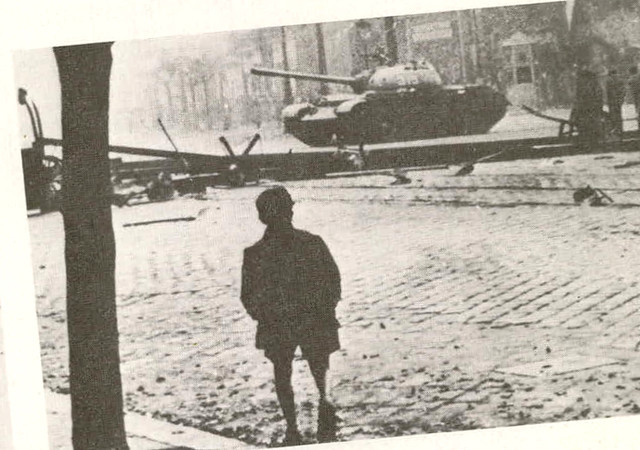
A Soviet tank at a street barricade in Budapest in October 1956
A Soviet tank tries to clear a road barricade in Budapest, October 1956 (Photo: CIA)
My wife Marilyn says I hear what I want to hear. She has said it for 49 years, mostly in October, when the Cardinals are done and I tell her next year looks good.
Christopher Squire helped write the same thing about a whole country, in a Secret paper sent from Budapest on December 18, 1956. It does not claim our radio promised Hungary help. Hungarians remember promises, it says, that were never literally made.
Here’s the part that gets me… the same paper admits the US Legation hardly listened to Radio Free Europe.
To see what Squire was answering, you have to go back eight weeks. On October 23, 1956, students marched in Budapest.
Hungary was a Soviet satellite then. By midnight, the US Legation was wiring Washington.
Radio Free Europe had talked to Hungary from Munich for years. Hungarian exiles wrote the shows, and Americans ran the station. Two days into the uprising, the CIA sent the station written advice.
Hungarians kept tuning in through the fighting. Later they charged the United States, the Legation wrote, “with not having come to their aid.” They pointed to Radio Free Europe “promises.”
On November 4, Soviet forces came back into Budapest and crushed the uprising. About 200,000 Hungarians fled the country.
Who wrote this?
Four lines about American radio in Hungary, all from 1956. Guess which came from the US Legation and which from its critics.
Hungary should be treated as “a small tessera in a vast mosaic.”
Radio Free Europe’s long daily hours are “a questionable expenditure of money and effort.”
Hungarian complaints about the radio should be “accepted at face value.”
If US policy stays negative, Radio Free Europe deserves “a drastic curtailment” in its hours.
Answer at the bottom of this letter.
“We are still faced with the fact that the Hungarians for the most part did interpret our broadcasts in a manner probably never intended or foreseen.”
US LEGATION BUDAPEST, DESPATCH NO. 247, DEC. 18, 1956
The despatch
Document
Despatch No. 247, “Comments on Media Policy and Media Treatment of Current Hungarian Events”
Dated
December 18, 1956
From
American Legation, Budapest
To
Department of State, Washington
Drafted by
Nyerges and Christopher A. Squire, as filed
Classified
Secret
File
Central Files, 764.00/12–1856
Published
1990, Foreign Relations of the United States, 1955–1957, Vol. XXV, Document 214
Squire and his wife Patricia got to Budapest that same November. Her oral history dates the tour from November 1956 to December 1958.
For close to two months, the Legation talked with Hungarians. It heard blame, and most of the blame fell on the radio.
And here is where 26 years of pulling files made me sit up. Squire and Nyerges passed up the easy way out, which was to quote the scripts. A close read of them, they wrote, would prove little.
The trouble was how Hungarians heard the broadcasts, and a script can’t show you that. They blamed their own side too. Our intelligence failed, they wrote, “to gauge correctly the temper of the Hungarians.”
The Legation sent that to Washington anyway, classified Secret.
Washington printed it in 1990, in its Foreign Relations series. That was 34 years later. Here is the page where the Legation draws its line on the promises.
AMERICAN LEGATION
BUDAPEST, HUNGARY
S E C R E T   DECLASSIFIED
No. 247   December 18, 1956
TO: Department of State, Washington
SUBJECT:  Comments on Media Policy and Media Treatment of Current Hungarian Events
RFE, however, continued to pursue a stronger line, and when Hungarians charge us with not having come to their aid they in general refer to RFE “promises.” These promises, the Legation is sure, were never literally made.
Published
1990
FRUS Vol. XXV
 
Source: Department of State, Central Files, 764.00/12–1856. Printed in FRUS 1955–1957, Vol. XXV, Doc. 214, history.state.gov.
From the march to the printed page
October 23, 1956: Students march in Budapest. By midnight the US Legation is cabling Washington.
October 25, 1956: The CIA’s International Operations Division sends Radio Free Europe policy guidance for the revolution.
November 4, 1956: Soviet forces return in strength and crush the uprising.
November 26, 1956: Deputy Under Secretary of State Robert Murphy finishes his review of selected Radio Free Europe Hungarian scripts.
December 4, 1956: CIA Inspector General Lyman Kirkpatrick sends Allen Dulles his review of Radio Free Europe.
December 18, 1956: Despatch No. 247 leaves Budapest for Washington, classified Secret.
1990: The State Department prints it as Document 214 of Foreign Relations, 1955–1957, Volume XXV. Thirty-four years on.
Ray’s note
The file number reads 764.00/12–1856. A clerk sees Hungary, political affairs, December 18, 1956 in that string. I could have pulled it before my coffee cooled. It took 34 years to reach print.
Line of the Day
“[T]he broad contours of our expression meant one thing to the speaker and another to the listener.”
Despatch No. 247, US Legation Budapest to the Department of State, December 18, 1956
Drafted by Nyerges and Christopher A. Squire. FRUS 1955–1957, Vol. XXV, Doc. 214
The answer
All four lines come from Despatch No. 247. The US Legation in Budapest wrote every one of them about American radio, in a Secret paper to its own government.
When a listener hears a promise the speaker never made, who carries it?
Tap one. Your mail app opens a letter to my desk with your answer in the subject line.
One tap, no login.
Did your family come over from Hungary after 1956? Hit reply and tell me what they heard on the radio that fall. I read every letter at the dining room table, with Marilyn asking me to clear off the scanner.
The request desk
Is there a file you have always wanted pulled? Send me the program, the year or the man, and I will tell you what I find and what I cannot.
NAME A FILE →
What I still cannot find
Despatch 247 rests on conversations in Budapest. These are the pieces I could not lay hands on.
▪  The names of the Hungarians the Legation talked with. The printed despatch gives none.
▪  Nyerges’s first name. The drafting line in the 1990 volume carries the surname alone.
▪  A clean text of Lyman Kirkpatrick’s December 4, 1956 review for Allen Dulles. The Wilson Center has it only as a scanned page, freed by a CIA review.
Marilyn is right about me most Octobers. I hear a pennant in a September win streak, and the Cardinals promised me nothing of the kind.
Hungary heard a promise in a radio it trusted. Squire and Nyerges wrote down why: one thing to the speaker, another to the listener.
Seventy years ago tomorrow, the students marched.
Talk tomorrow,
Ray
Further Reading:
“These promises, the Legation is sure, were never literally made.” Read it all: FRUS 1955–1957, Vol. XXV, Doc. 214.
“Policy Considerations for Radio Free Europe Broadcasts” is the CIA advice sent two days in: Wilson Center.
“Budapest, Hungary Nov. 1956–Dec. 1958” is how Patricia Squire’s oral history lists the tour: ADST oral history.
“A popular Government, without popular information, or the means of acquiring it, is but a prologue to a Farce or a Tragedy; or perhaps both.”
JAMES MADISON, LETTER TO W. T. BARRY, AUGUST 4, 1822